Painting the Feeling, Not the Photograph
People often ask whether I use photographs as references for my artworks.
The answer is yes, I do … but only as a starting point. Every piece begins with a freehand drawing before gradually becoming its own interpretation.
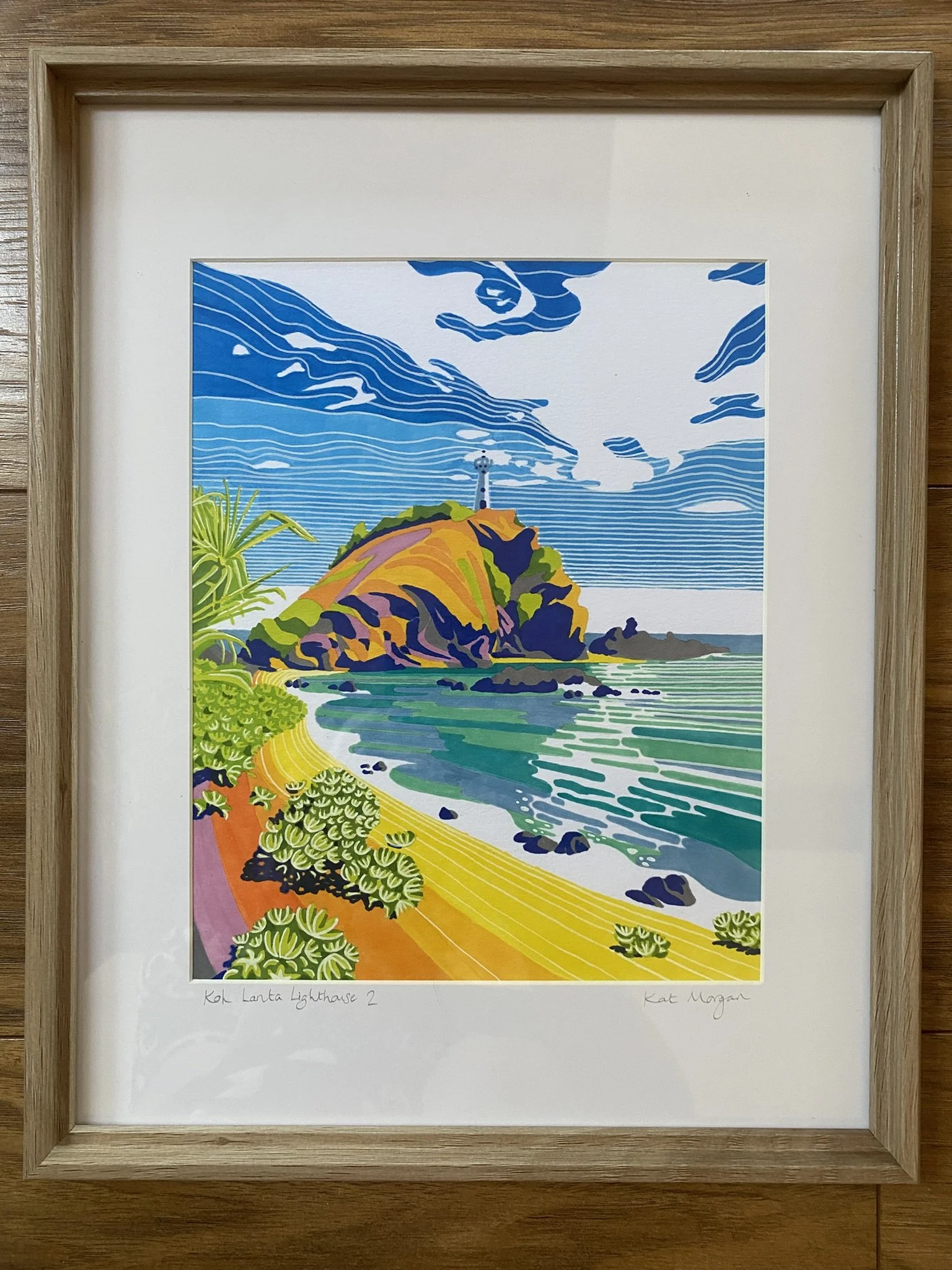
For my landscape piece exhibited as part of the Swindon Arts Fringe Festival, I worked from a photograph I took while travelling. Looking back at it now, the scene is recognisable, but the finished artwork is quite different. The perspective has been exaggerated, unnecessary details simplified, and perhaps most noticeably, the colours have become far more saturated.
Why?
Because photographs are brilliant at recording what something looked like, but they’re not always very good at capturing what it felt like to be there.
When I look back to that day, I don’t remember exact shades or perfectly accurate proportions. I remember the warmth of the sun on my skin, the dazzling brightness of the sand, the vivid blues of the sea, and the energy of the place. Those are the memories that stay with us long after we’ve forgotten the finer details.
Rather than copying every element of the original scene, I chose to distil it into something simpler. By reducing visual clutter and using bold, expressive colour, I hoped to create an artwork that communicates an atmosphere as much as a location.
When I paint flowers or plants, my starting point is often careful observation. I’m fascinated by the way light falls across a petal or the richness of colour within a leaf. But travel is different. Those places aren’t simply subjects to paint—they’re places I’ve experienced. Every photograph carries memories that extend far beyond what the camera captured: the warmth of the sun, the sound of waves breaking on the shore, salty sea air and the feeling of discovering somewhere new.
Those experiences become inseparable from the image itself.
When I return to those photographs in the studio, I’m not trying to recreate them exactly. I’m trying to paint everything the photograph can’t hold. The exaggerated colours, simplified shapes and shifted perspectives are all part of telling that bigger story—the one stored in memory rather than on a memory card.
Yet my hope is that the finished painting doesn’t just reflect my memory of a specific place. You don’t have to have stood on that particular beach or visited that exact lighthouse to connect with it. Perhaps it reminds you of a holiday on a Greek island, a walk along the Cornish coast, or simply the feeling of standing in warm sunshine with a sea breeze on your face. Our own memories naturally find their way into the paintings we look at, often filling in the spaces with places and moments that matter to us.
If that happens, then I think the painting has achieved its purpose. It has moved beyond documenting one place and instead become a reminder of a feeling many of us recognise.
Photographs record where we were.
Paintings can remind us how it felt to be there.
Photographs record a moment. Paintings can record a memory.